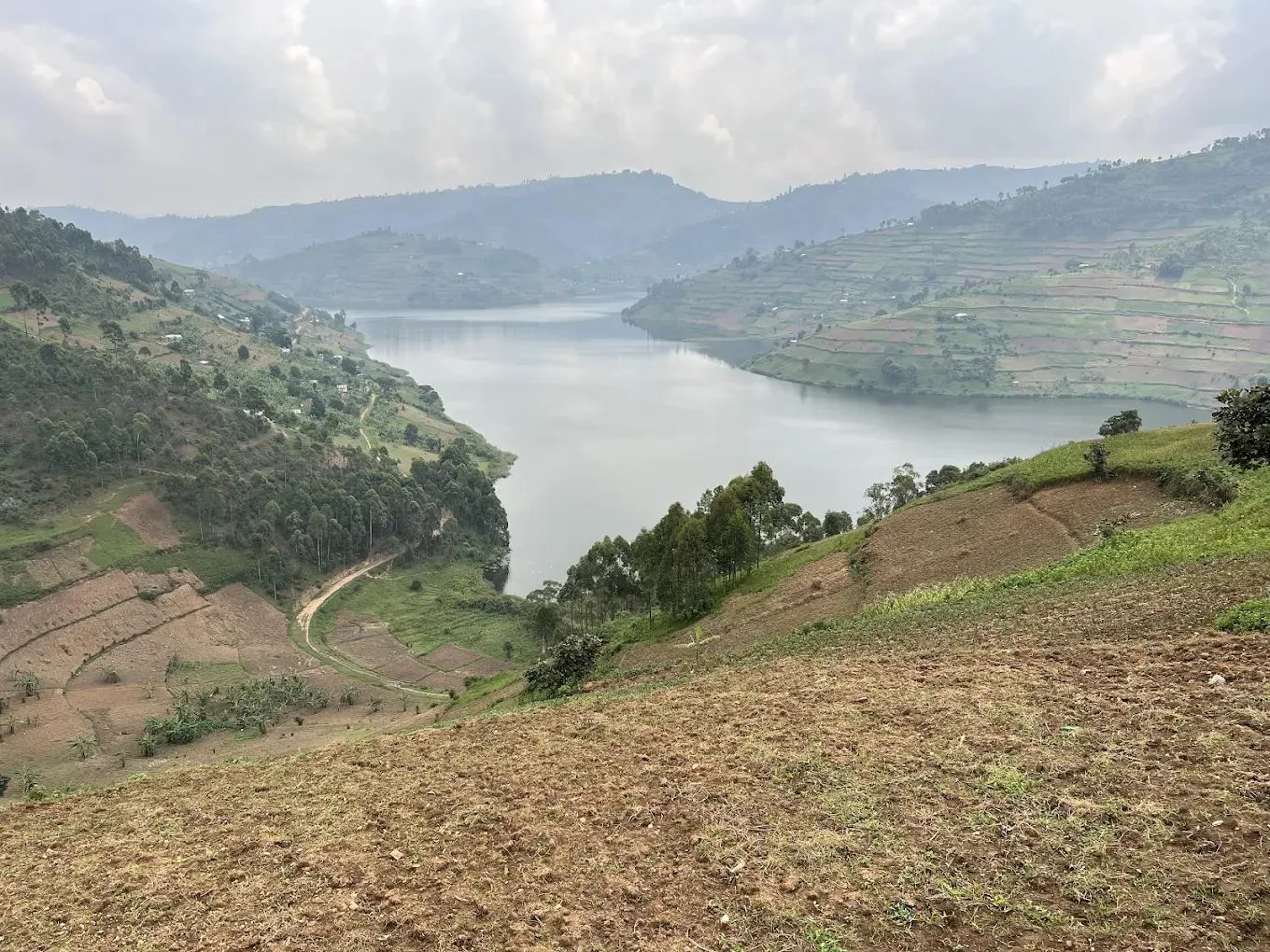
There is a moment, somewhere on the water between islands, when Lake Bunyonyi stops being a destination and becomes something harder to name. The hills rise on every side in steep green terraces, sorghum and potatoes and beans climbing almost vertically into a sky that sits low and close, pressed down by altitude. A dugout canoe cuts a silence you did not know you were carrying. Then a kingfisher drops like a dart of electric blue, and you understand, finally, why the people who live here gave this place a name that means little birds.
Bunyonyi: the lake of small birds. More than 200 species weave through the reeds and wetlands, nest in the island trees, and trace arcs over water so dark it seems to have no bottom. Local lore calls it the second deepest lake in Africa, with depths of up to 900 metres. Scientists who have actually surveyed it put the figure closer to 40 metres. Either way it is the deepest lake in Uganda, and deep in more than the geological sense.
The lake holds stories. Some are joyful, some are hard, and one of them, unfolding through 2025, asks us to look at this beloved place with honest eyes.
Born of fire, shaped by time
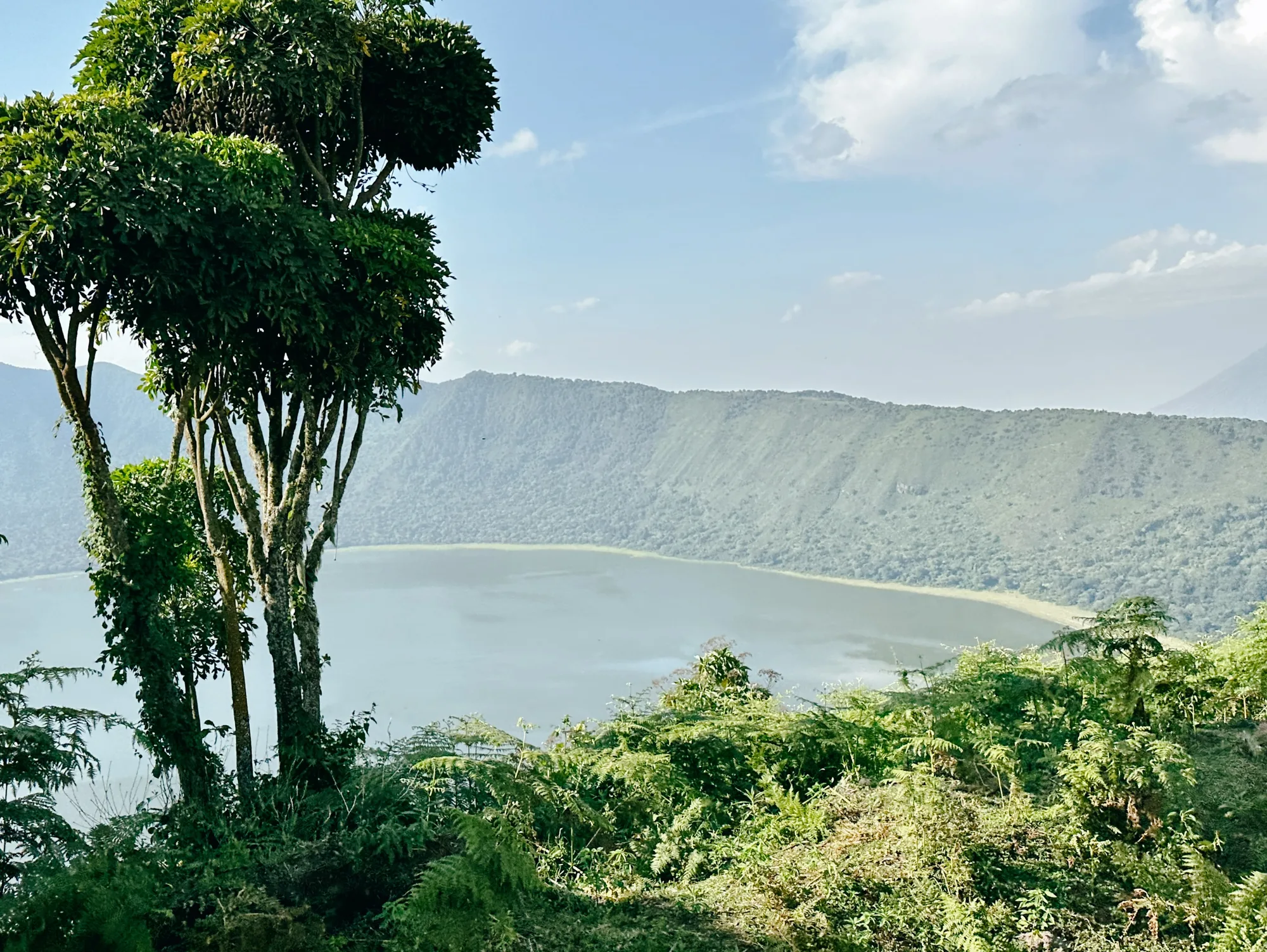
Lake Bunyonyi did not simply appear. Thousands of years ago, lava from the Virunga Mountains, the same chain that today shelters the last mountain gorillas, dammed a highland river valley and trapped water between the hills. What fire sealed became, over time, one of the most unusual lakes in East Africa.
Set at 1,962 metres above sea level between the districts of Kabale and Kisoro, pressed against the border with Rwanda, the lake sits in a world apart. The altitude gives it a temperate climate: cool, mist-wrapped mornings and warm afternoons that feel earned rather than assumed. Travellers reach for Switzerland when they describe it, grasping at the sense of vertical landscape and water held in a bowl of mountains. Bunyonyi is wilder than that comparison suggests.
The lake runs about 25 kilometres long and 7 kilometres at its widest, across some 61 square kilometres. It is famously bilharzia free, crocodile free and hippo free, which makes it one of the safest lakes in the region to swim, a genuinely rare thing in this part of Africa.
| At a glance | |
|---|---|
| Location | Kigezi Highlands, southwest Uganda |
| Altitude | 1,962 metres above sea level |
| Size | About 25 km long, 61 km² |
| Islands | 29 |
| Birdlife | Over 200 species |
| Swimming | Bilharzia, crocodile and hippo free |
It also has a biology of its own, including freshwater crayfish that few other Ugandan lakes share. The Batwa and the Bakiga who have lived here for generations did not describe it in those terms, but they understood that this place was unlike any other, and built their lives around it accordingly.
Two peoples, one shoreline
Bufuka Village, the main hub on the lake’s edge, is home to two communities whose histories could hardly be more different, and whose presence side by side is one of the quietly remarkable facts of this corner of Africa.
The Bakiga, the people of the mountains, are the cultivators of southwest Uganda. Hard-working and fiercely independent, they terraced these near-vertical hills into farmland centuries ago. They fish, they trade, and they keep oral traditions of real richness, including songs and proverbs in which the lake appears as both character and teacher. Their sorghum drink, obushera, brewed in clay pots and passed between neighbours, is as much an institution here as the morning mist.
The Batwa tell a different story. Among Uganda’s oldest forest peoples, hunter-gatherers who lived for millennia in the forests of Bwindi and Mgahinga, they were expelled when those forests became national parks, displaced in the name of gorilla conservation without compensation or alternative land. The Batwa who settled around Lake Bunyonyi arrived as refugees from their own homeland. Today, visitors can sit with Batwa performances, dances and oral histories that carry both the grief and the resilience of a people learning to live somewhere they did not choose.
The Bakiga farmed the hills. The Batwa remembered the forest. The lake became the space where both peoples slowly learned to share.
Any visit that skips the Blacksmith Heritage Trail near Bufuka, the Bakiga Cultural Museum, or a morning with a Batwa elder has missed the lake’s truest dimension. The birds are magnificent and the scenery is extraordinary, but the human story is what makes Bunyonyi irreplaceable.
The island stories
Of the 29 islands scattered across Bunyonyi, most travel writing reaches for the same handful of adjectives: lush, picturesque, tranquil. But each island is a chapter. These are the ones that matter most.
Akampene, the Punishment Island
Barely larger than a tennis court, this tiny outcrop is at once the most visited and the hardest to visit. It was once where the Bakiga abandoned unmarried pregnant girls, left without food or shelter to die, or to be taken by a suitor too poor to afford a bride price. The practice, rooted in a harsh logic of honour and bride wealth, was mercifully abolished long ago. Today the island is eroding, the lake slowly eating its base, and one day it will be gone. What remains is a single tree, silence, and the weight of the past.
Bwama, the island of healing
In the 1920s, the British missionary doctor Leonard Sharp arrived at the lake and saw people with leprosy turned away by their own communities. He established a treatment centre on Bwama, the largest island, with care, housing and a school. What was once a place of quarantine is now home to a thriving school, where children still paddle across in wooden canoes each morning for their lessons.
Kyahugye, the zebra island
A curious footnote in Uganda’s story: zebras, reportedly relocated from Lake Mburo, graze a private island here, miles from any savannah. The herd has thinned over the years, but those that remain are a strange and wonderful sight, reflected in highland water.
Bushara, the conservation anchor
One of Bunyonyi’s most popular overnight islands, Bushara is where tourism and ecology negotiate most visibly, with guided nature walks, birding trails and community programmes. It is an imperfect, evolving model of what responsible travel at the lake could look like if it were taken seriously across the board.
There is also Bucuranuka, the island that overturned, whose name preserves the memory of a canoe disaster generations ago. Oral history and geography fused into a single word. This is what these highlands do: they keep the past in the landscape.
The lake in crisis
Here is what the glossy brochures leave out. In late August 2025, Lake Bunyonyi turned brown.
Not the gentle amber of late light on water, but a deep, murky, foul-smelling brown, with an oily film on the surface and white scum gathering at the shore. Fish rose to gasp at the surface. Residents who depend on the lake as their only water source described real alarm, and visitor numbers fell.
What turned the water brown, 2025. Uganda’s Ministry of Water and Environment attributed the change to a mix of causes: a natural lake turnover, when cold, oxygen-poor water from the depths rises and mixes with the surface after heavy rain; agricultural runoff from the surrounding hills; siltation from construction and mining; and, beneath it all, decades of deforestation that stripped away the vegetation that once filtered what reached the lake. Tests found very low oxygen in the deeper layers. Parliament debated the response in September 2025, and recovery is still being monitored.
What happened was less an accident than a reckoning, the result of pressures that had been building for years as the catchment absorbed more farming, more settlement, more extraction and less forest. The terraced hills that make Bunyonyi so beautiful are also, once stripped of their cover, among its greatest threats.
Lake Bunyonyi is not only a tourist gem. It is a source of water, food and identity for tens of thousands of people. Its health is their health.
The government has committed to demarcating shoreline buffer zones, replanting catchment areas, upgrading water treatment and educating communities on lake stewardship. Whether those commitments turn into action, and how fast, is the question that will define Bunyonyi’s next chapter.
For travellers, this matters. Visiting Bunyonyi is not a neutral act. Every lodge you choose, every boat you hire from a local operator, every meal sourced from the lakeshore either reinforces or interrupts the patterns that brought the lake to crisis. Responsible travel here is not an optional extra. It is the condition.
Why you should still go
Some places are beautiful. Lake Bunyonyi is necessary.
In a world saturated with travel content, this lake, misty and storied and wounded and extraordinary, offers something rarer than scenery. It offers encounter: with a history that does not flinch, with peoples whose dignity has survived displacement and disruption, and with a landscape that is actively teaching the people who love it what it costs to be loved carelessly.
Come for the dawn, when mist clings to the water and grey crowned cranes call across the wetlands. Come for the canoe at dusk, sliding between islands as weaver birds settle into the last light. Come for the coffee grown on these hills, among the finest in East Africa, drunk while the terraces turn gold.
Come for the hard conversation with a Batwa elder about what was lost when the forest closed, and for the children on Bwama who paddle to school each morning, inheriting an island whose past they did not make and whose future they will decide.
Lake Bunyonyi is not a postcard. It is alive, complicated and, like all living things, in need of care. Travel to it with the full weight of that understanding, and it will give you far more than you expect. That, after all, is what the best travel always does.
Planning your visit
Lake Bunyonyi lies in Uganda’s Kigezi Highlands, roughly 8 to 10 hours by road from Kampala via Mbarara and Kabale, or reached by light aircraft to a nearby airstrip followed by a short drive. From the Katuna border it is about an hour to Kabale, and another twenty minutes to the lakeshore.
The lake is a natural pause between Bwindi Impenetrable Forest and the Rwanda border, which is why so many of our itineraries fold in two or three nights here to rest after the exertion of a gorilla trek. Our 12 Days Uganda Gorilla & Wildlife Safari does exactly that, and you can see the wider picture in the Uganda destination guide or browse all our Uganda safaris. For timing, our guide to the best time for gorilla trekking applies to the lake as well: the drier months of June to September and December to February are the most reliable, while the green seasons are quieter and lusher.
Accommodation runs from eco-island lodges to modest lakeside guesthouses. Ask your hosts how their waste is handled, where their food is sourced, and whether their boats are operated by local people. These are not awkward questions. They are the right ones, and at Lake Bunyonyi they matter more than almost anywhere.
When you are ready to plan a journey built around honest, community-led travel, speak to an Expert and we will shape it around your dates, your pace and the things you most want to see.