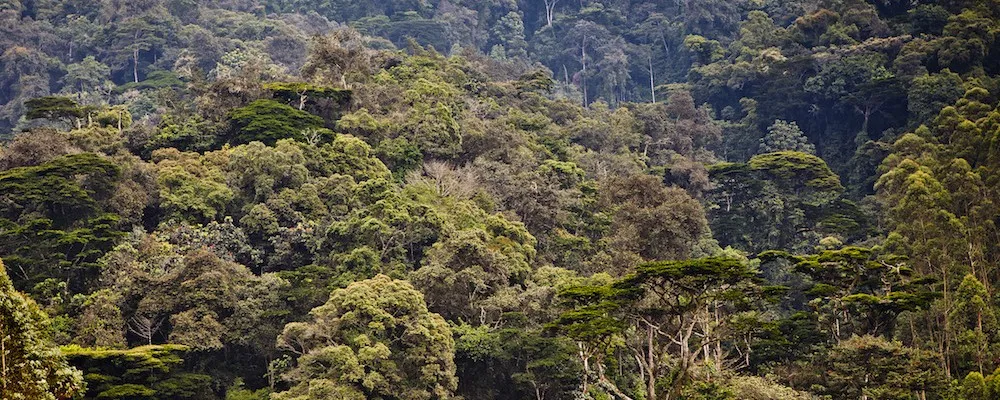
Maramagambo Forest is a 300 sq km tropical rainforest in the southern sector of Queen Elizabeth National Park, and one of Uganda’s most biodiverse habitats. It is home to chimpanzees, forest elephants, red-tailed monkeys, and the famous python cave, a bat cave where African rock pythons hunt roosting bats in the dark. Most visitors pass through the forest on the way to the Ishasha sector, so the trails here are genuinely quiet.
Where Is Maramagambo Forest?
Maramagambo Forest is situated adjacent to the Queen Elizabeth National Park’s main tourist areas and forms a vital part of the park’s ecosystem. The forest lies near the border with the Democratic Republic of Congo and is closely linked to the greater Albertine Rift montane and lowland forest systems.
Key features of Maramagambo Forest include:
-
Dense tropical rainforest with a closed canopy averaging 20 to 30 meters in height.
-
A network of underground caves including the famous Faimbe Cave and Nyamuriro Cave, attracting spelunkers and researchers.
-
Numerous streams and swampy areas supporting wetland biodiversity.
Wildlife and Biodiversity in Maramagambo
Maramagambo Forest is a biodiversity hotspot, home to an array of species, many of which are rare or endemic:
-
Mammals: The forest shelters populations of chimpanzees, forest elephants, leopards, and several species of monkeys including the black-and-white colobus and L’Hoest’s monkey.
-
Birds: With over 400 bird species recorded, it is a haven for ornithologists and bird watchers. Notable species include the Great Blue Turaco, African Green Broadbill, and the elusive Congo Peafowl.
-
Reptiles and Amphibians: The forest supports a variety of snakes, lizards, frogs, and toads, contributing to its ecological complexity.
-
Flora: The canopy hosts a diverse range of hardwood trees, medicinal plants, orchids, and ferns, many of which have significant ecological and ethnobotanical value.
Ecological Role of Maramagambo Forest
Maramagambo Forest plays a crucial role in maintaining the ecological balance of the Queen Elizabeth National Park and the broader Albertine Rift region:
-
Water Catchment: The forest’s dense vegetation and soil cover help regulate the hydrology of nearby rivers and lakes, contributing to water quality and availability.
-
Carbon Sequestration: As a tropical rainforest, Maramagambo acts as a vital carbon sink, mitigating climate change impacts by absorbing large amounts of CO₂.
-
Habitat Connectivity: It serves as a wildlife corridor linking different parts of the park and adjoining forests in the Democratic Republic of Congo, facilitating animal movement and genetic exchange.
What to Do in Maramagambo Forest
Maramagambo Forest attracts eco-tourists, scientists, and adventure seekers alike:
-
Chimpanzee Tracking: One of the forest’s main attractions is chimpanzee trekking, offering visitors a rare opportunity to observe these intelligent primates in their natural habitat.
-
Cave Exploration: The network of caves provides thrilling spelunking experiences and scientific study opportunities into subterranean ecosystems and geology.
-
Bird Watching: With its rich avifauna, the forest is a hotspot for birding enthusiasts, especially during migration seasons.
-
Research Hub: Ongoing studies focus on wildlife ecology, forest dynamics, and conservation biology, contributing valuable data to global biodiversity knowledge.
Conservation Challenges and Efforts
Despite its protected status, Maramagambo Forest faces several threats:
-
Illegal Logging and Charcoal Burning: These activities degrade forest cover and threaten wildlife habitats of species like the chimpanzee.
-
Human-Wildlife Conflict: Encroachment into forest areas can lead to conflicts with animals such as elephants.
-
Climate Change: Altered rainfall patterns and temperature changes impact forest health and species distribution.
Conservation initiatives led by the Uganda Wildlife Authority (UWA), in collaboration with international NGOs and local communities, focus on:
-
Anti-poaching patrols and law enforcement
-
Community education and engagement to promote sustainable resource use
-
Habitat restoration programs and scientific monitoring
Cultural Significance for Local Communities
For the indigenous communities surrounding the forest, Maramagambo holds cultural and spiritual value. Traditional beliefs often regard the forest as sacred, and it features prominently in local folklore and customs.
Sustainable tourism in the forest offers avenues for these communities to share their heritage while benefiting economically.
Maramagambo Forest stands as a vital ecological, cultural, and scientific asset within Queen Elizabeth National Park. Its rich biodiversity, unique geological formations, and critical environmental functions underscore its importance in Uganda’s natural heritage.
Protecting and sustainably managing Maramagambo Forest ensures that future generations can continue to experience — learn more on our conservation page and learn from this remarkable tropical rainforest an emblem of Africa’s wild and wondrous landscapes.
Maramagambo is included as a guided walk on our 10 Days Uganda Safari Holiday and can be added to the 8 Days Primates and Wildlife Safari as an afternoon excursion within Queen Elizabeth. The 5 Days Uganda Gorilla and Wildlife Adventure combines the forest with a Bwindi gorilla trek for guests with limited time. Pair your visit with Kyambura Gorge, a chimpanzee gorge an hour’s drive away. Read our full Queen Elizabeth National Park guide for the complete picture. To explore everything Uganda has to offer beyond Queen Elizabeth, our Uganda destination guide covers the full picture.